Magnatune home page Genres Music licensing Member login Info
Magnatune home page
Information: about Magnatune
Search:

Part of these collections: Philharmonia Baroque and its Musicians, Recorder, Renaissance.

Customers who bought Farallon Recorder Quartet also bought: American Bach Soloists, Lara St John, Philharmonia Baroque, Monks and Choirs of Kiev Pechersk Lavra, Rob Costlow, Jeff Wahl, Falling You, Vito Paternoster, Ambient Teknology, Robert Rich.

All audio files at Magnatune are licensed under the Creative Commons Attribution-NonCommercial-ShareAlike license.

Farallon Recorder Quartet: renaissance recorder ensemble

- Ludwig Senfl play hifi lofilicenseBUY

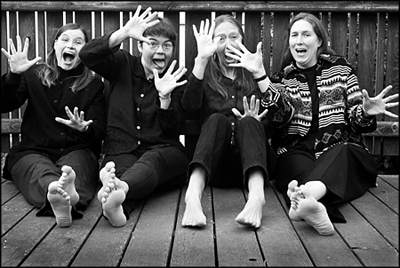
artist photo

The Farallon Recorder Quartet gives inspiring performances of a vast and varied repertoire extending across time and genre. Bach and Gershwin, Ockeghem and Serocki; sedate, wild, sublime, cutting edge and traditional, Farallon Recorder Quartet does it all with style.

Formed in 1996, the Farallon Recorder Quartet takes its name from the rugged Farallon Islands off the coast of San Francisco. The quartet applies extensive knowledge of performance practices to music from eleven centuries, reaching out to modern audiences in an accessible and exciting manner. Farallon has performed for the Phoenix Arizona Early Music Society, Bay Area Recorder Series, Atlanta Early Music Alliance, at the American Bach Soloists Summer Festival, and with world-renowned guest artist Marion Verbruggen. Farallon's debut CD, a collection of sacred and secular works by the 16th century composer Ludwig Senfl, was released January 21, 2005.

Farallon Recorder Quartet performs on numerous types of recorder from renaissance to modern, from sopranino to contrabass, from 6 inches to 6 feet tall. Dutch recorder builder Adriana Breukink made a set of ten renaissance recorders especially for Farallon. The quartet performs all its renaissance music on these spectacular instruments, creating a warm and wondrous tone of beauty.

While devoting much of their concert programs to renaissance and baroque music, Farallon Recorder Quartet is also active in performing 20th and 21st century music, both well established works, and newly composed pieces, some of which have been written for the ensemble.

Letitia Berlin is the director of a Recorder Elderhostel and a masterclass/workshop for recorder, viola da gamba and harpsichord at the Hidden Valley Institute of the Arts in Carmel Valley, CA . Ms. Berlin has performed with the Carmel Bach Festival and the Atlanta Baroque Orchestra as well as other ensembles. Recordings include Ladino love songs with Yatan Atan on the New Albion label and the second edition of the Disc Continuo. Ms. Berlin received a master's degree in early music performance practices from Case Western Reserve University and a bachelor of music from the University of North Carolina at Greensboro. Her mentors and teachers include Ross Duffin, Carol Marsh, Marion Verbruggen and Paul Leenhouts.

Frances Blaker received her Music Pedagogical and Performance degrees from the Royal Conservatory of Music in Copenhagen where she studied with Eva Legene. She also studied with Marion Verbruggen in the Netherlands. Ms. Blaker has performed as a soloist and with various ensembles in the United States, Denmark, England and the Netherlands, most recently with the Atlanta Baroque Orchestra. She teaches privately and at workshops throughout the United States, including the San Francisco Early Music Society Baroque workshop and Port Townsend; she is co-director of the Amherst Early Music, Inc. Ms. Blaker is the author of The Recorder Player's Companion and the "Opening Measures" column in the American Recorder, and a collaborator and performer on the Disc Continuo series of recordings. Ms. Berlin and Ms. Blaker were awarded the first recorder residency at the Sitka Center for Art and Ecology in Otis, Oregon.

Louise Carslake is well known to Bay Area audiences as a performer on the baroque flute and the recorder. She is a member of the baroque ensemble Music's Re-creation, the Farallon recorder quartet, and Magnificat, and has performed widely in her native Britain, as well as in New Zealand, Poland, Ireland, China and the Netherlands. She has recorded for radio and television internationally, and has made compact disc recordings for the Meridian, Centaur, Intrada, and Musical Heritage labels. Louise holds the graduate teaching diploma from Trinity College of Music, London, and the diploma for baroque flute performance from the Arnhem Conservatory in the Netherlands, where her teacher was Wilbert Hazelzet. She also studied baroque music performance practice with Nikolaus Harnoncourt at the Mozarteum in Salzburg, Austria. In addition to her performing activities, Louise teaches on the faculty at Mills College, and is an active teacher at her home studio in Oakland. She is co-director of the San Francisco Early Music Society's Medieval Renaissance Workshop.

Hanneke van Proosdij studied recorder with Michael Barker at the Royal Conservatory in The Hague, the Netherlands, where she also studied harpsichord and composition. She received her DM (teachers diploma) in 1992 and UM (soloist diploma) in 1995. She performs regularly with Philharmonia Baroque Orchestra, the American Bach Soloists, Chanticleer, Magnificat, Berkeley Symphony, Orinda and Parnassus Avenue. She has appeared at the Berkeley Early Music Festival, Internationale Handel Festspiele, Festival d'Ambronnay, Wratislavia Cantans, Contemporary Improvised Music Festival and the Amherst Early Music Festival. Hanneke is a co-founder of the Junior Recorder Society in the East Bay as well as the director of the SFEMS Medieval Renaissance Workshop.

Hanneke van Proosdij also has a solo album on harpsichord at Magnatune.

Instruments used for this recording:

Recorders: Adriana Breukink & Peter van der Poel
Organ: J. Bennett and G. Giuttari, Boston 1994 after Manderscheidt
Engineering & Mastering: David Tayler
Producers: Kit Higginson & David Tayler
Digital editing: Hanneke van Proosdij, David Tayler and Robert Claire
Recorded November 2001 and June 2004 at St Stephen's Church, Belvedere, CA
Photographs by Sheila Newbery

Ludwig Senfl began his musical life as a choir boy in the court of Maximillian I. A small child, far from his Swiss home, Ludwig traveled with the Imperial Court, singing music by the great composers just a few decades older than himself - Josquin and Isaac among them. As was common for a member of the choir, Senfl studied for the priesthood, and took orders while the Imperial Court was in Konstanz.

Senfl tells us that Isaac was his teacher; they traveled together, spending time in Konstanz and Florence. When Isaac was commissioned to write a cycle of Mass Propers for the Cathedral in Konstanz in 1507-8, it was Senfl who was his scribe. In 1550-55, many years after Isaac's death, Senfl prepared these works for publication under the title Choralis Constantinus.

As Isaac aged and began to withdraw from his duties Senfl stepped in, succeeding to his position as imperial court composer at Isaac's death in 1517. This position was not to last long however, as the court musical establishment was dissolved after Maximillian I's death in 1519. It is uncertain just how and where Senfl spent the next few years, but by 1523 he was employed as court composer to Duke Wilhem IV of Bavaria, where he remained for the rest of his life.

Ludwig Senfl composed masses, motets, songs and instrumental consort music. Although he did not himself write keyboard music, a number of his works appeared in keyboard versions. His works show such variety within this small number of musical forms. Each motet has its own character and themes. Every lied is a little gem of polyphony.

Senfl is best known in music history books as a composer of tenor lieder - a compositional form in which a song with German text, usually secular, but sometimes sacred, appears in the tenor voice while the other voices weave a polyphonic accompaniment of varying complexity. "How strange and wonderful it is that one voice sings a simple unpretentious tune while three, four, or five other voices are also sung; these voices play and sway in joyful exuberance around the tune..." (Martin Luther). Senfl wrote such songs for anywhere from four to seven voices, using one or more texts with their tunes. Here we present you with a selection of four-voice lieder. "Unsaeglich Schmerz" moves in slow stretched phrases; painfully pure and clear in its suspensions and harmonies; voices of equal prominence flow in lingering melodic lines. By contrast, "Ich weiss nit, was er ihr verhie§" presents its tune clearly in the tenor while the three other voices leap and dance around it in sparkling rhythmic patterns. Another song treatment appears in "Wann ich des Morgens frueh aufsteh'". Here Senfl presents the tune in each voice by turn, wandering off into meandering figuration when not playing the melody.

Lesser known today for his motets, Ludwig Senfl wrote some 240 such pieces showing remarkable variety of musical treatment. "Ecce quam bonum", performed at the opening of the 1530 Diet in Augsburg as a plea for harmony among religious factions, uses the text of Psalm 133 - "Behold, how good and how pleasant it is for brethren to dwell together in unity!" Here Senfl uses musical motifs that reappear throughout the work. The strong and definite introductory motive reappears not only during the Prima Pars, but, remarkably, also at the end of the Secunda Pars. Senfl contrasts a rich tapestry of polyphony with sudden homo-rhythmic exclamations before turning to falling cascades upon the word "descendit" in Prima Pars. Beginning with just two voices, the phrases tumble downward in ever thicker texture - another remarkable feature of this motet. Short statements are balanced by glorious long sinuous phrases. This motet is a most joyful and optimistic musical statement, as perfect as a well-wrought short story.

By contrast, the motet "In pace in idipsum" is nearly transparent. Each section begins with just one voice, the others entering in imitation. The texture is light and clear, the harmonies open and uncomplicated. Senfl may have met Martin Luther and corresponded with him. During the Diet of Augsburg in 1530 Luther wrote a letter to Senfl, asking him to send a composition. Senfl sent Luther two motets: "Non moriar, sed vivam" and "In pace in idipsum" which was regarded as lost until recently located in the "Schalreuter Codex" in Zwickau. This motet uses bits of text Psalms 4 and 131 whereas the other motets here use entire Psalm texts.

In "Domino confido", a motet upon the text of Psalm 11, uses imitation almost throughout, in longer and shorter motifs, the entire ensemble coming together at the word "justus" at both appearances of this word - one in the Prima Pars, the other in the Secunda Pars. The final motif of Secunda Pars is repeated numerous times to very moving effect - Quoniam justus Dominus et justitias dilexit (For the righteous Lord loveth righteousness; his countenance will behold the thing that is just).

Senfl's instrumental music, though relatively few in number of pieces, is once again greatly varied. Compare Lamentatio with its contemplative, lush sounds and long phrases to the energy and complexity of Tandernac, perhaps Senfl's best-known piece in our time. Lamentatio is a free-composed quartet of equal voices, while Tandernac can be thought of as an instrumental form of the tenor lied with the popular Dutch tune appearing in canon in tenor and bass while the upper voices cavort around it in exuberant flights of fancy.

Prolific and imaginative, Ludwig Senfl was truly one of the great composers of the Renaissance. Today Senfl's music is little known except for a handful of compositions. It is our hope that this recording will help to fill this gap. We wish to move the hearts, excite the minds and prick the curiosity of our listeners. Frances Blaker, 2004